
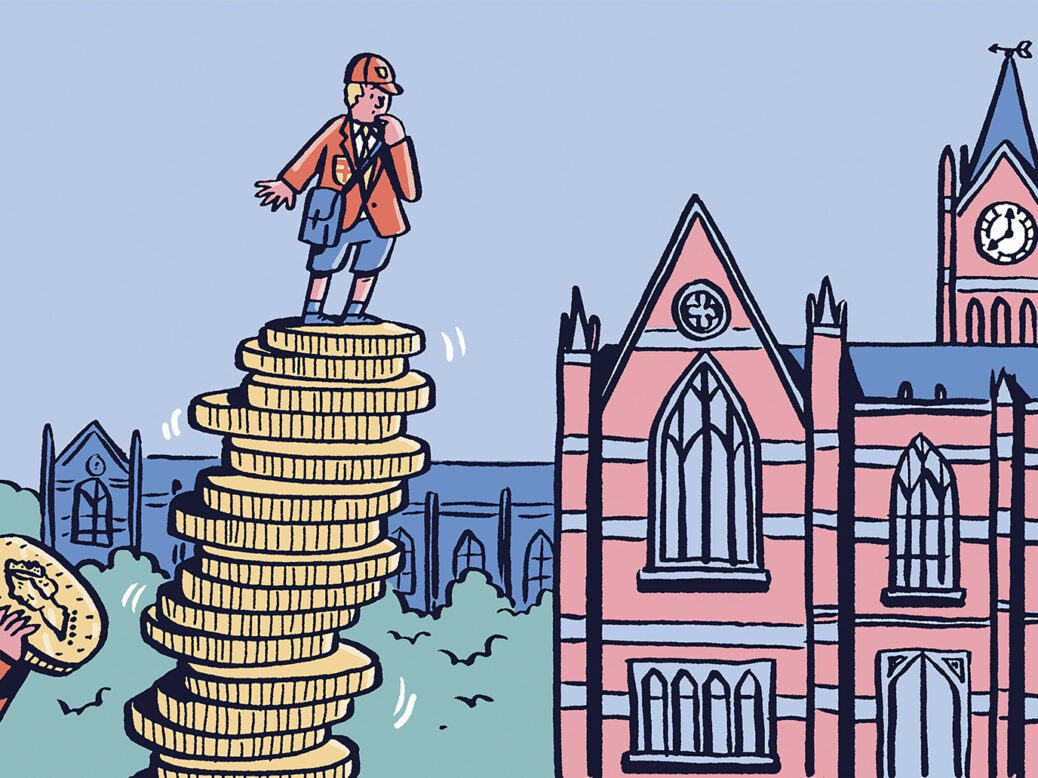
Earlier this month, the press regulator Ipso upheld a complaint against the Telegraph for breaching its editors’ code of practice by publishing an article about a hard-working family hit by rising private school fees that turned out to be entirely fabricated. The story, published in May last year, was of the sort that might feel familiar if you’ve read the right-leaning press in the two years since Labour included its intention to end the VAT exemption on private school fees in its manifesto. Al Moy, a 38-year-old investment banker, and his wife, Alexandra, had been forced to make considerable sacrifices to keep their children in their schools. “We earn £345k, but soaring private school fees mean we can’t go on five holidays”, the article was headlined. The paper could almost have been trolling itself.
Al, Alexandra, Ali, Harry and their third child, Barry, of course, are not real people (the names alone ought to have been a giveaway), and the glowing family photographs that accompanied the piece were stock photos. Bluesky and X users worked this out pretty quickly (the Telegraph removed the story hours after it was published and printed a correction). While the paper accepted that its internal checks “were not strong enough”, it was quick to believe a story that fit the private school lobby’s “we’re scrimping and saving to cover Rupert and Fenella’s fees – we’ve even had to give up the chalet in Courchevel!” narrative.
Citing confidentiality, the Telegraph declined to tell Ipso how the piece came to be published, but Press Gazette reports the case study was facilitated by Saltus – the same wealth management firm behind a survey written up in the Times days after the Ipso news broke. “Almost one in ten parents desert private schools after VAT fee rise”, the headline declared. In other words: more than 90 per cent of parents haven’t deserted private schools.
Both stories seem to speak to the hysteria of the right-wing press over what is often called a “raid” on private schools – language that makes it sound more like the pillaging of Lindisfarne, or an FBI training drill, than the end of a tax exemption. Headline after headline has warned of an “exodus” from private schools as a result of this raid, as parents priced out by fee hikes move their children to state schools, at great apparent cost and disruption to an already stretched sector. The imposition of VAT will not, the narrative goes, harm the ultra-wealthy, who can afford to absorb the cost, but instead the “squeezed middle”: those who have gone without to afford the best for their children – like Rishi Sunak, who missed out on Sky TV so his parents could pay his fees for Winchester College – and are now making greater still sacrifices to keep them in their schools.

It is not difficult to imagine why the right-wing press might be sympathetic to this story: the privately educated are twice as likely to vote Tory, and five times as likely to hold “elite” jobs such as in journalism, as the general population. But is it true?
A 2018 report from Baines Cutler Solutions and KPMG, commissioned by the lobbying group the Independent Schools Council (ISC), which represents around 1,400 private schools including Eton, Harrow and Cheltenham Ladies’ College, suggested that 17 per cent of ISC pupils – 90,000 – would leave the sector in the first five years after VAT was added to fees. The Institute for Fiscal Studies’s estimates were more conservative: between a 3 and 7 per cent reduction in pupil numbers. In reality, Department for Education figures for 2024-25, the school year in which the policy came into effect, show a 1.9 per cent fall in independent school pupil numbers. There are now just 552 fewer children in private schools than in 2015-16. (This decline is also partly explained by the falling birth rate: the number of state school pupils also dropped by 0.6 per cent.) Even if rolls continue to fall at a similar rate in the coming years, this is far from an exodus that will cause significant disruption to the state system.
As for the “squeezed middle”, there is minimal public data on the socio-economic backgrounds of the children who attend private school. The closest equivalent to the “free school meals” measure used in state schools is data on how many pupils receive a means-tested bursary or scholarship (as opposed to those offered to, say, military families). The ISC’s 2025 annual report shows that around 7 per cent of its pupils received one, and only 1.4 per cent paid no fees at all.
But we do not need more in-depth data on school demographics to observe that in England, the median household income after tax is £36,700, and that even before the VAT policy came into effect, the average private day fees were £18,000 a year. No doubt some parents do make sacrifices to send their children to private school, but no “middle earner” can cut back enough to make those numbers add up. Long before the VAT policy was first included in a Labour manifesto, fees were rising – by 20 per cent in real terms since 2010, and 55 per cent since 2003. Private schools did not need Labour’s assistance to price out the middle classes; they did it all by themselves.
Despite rising fees, the share of pupils in private schools has remained a reasonably steady 6-7 per cent. Indeed, while the demographics of pupils might have changed, roughly the same percentage of children attend private schools today as in 1960. Perhaps it is not two things that are certain in life, but three: death, taxes – and that a small but consistent percentage of parents will pay whatever it takes to pass their own privilege to their children.
[Further reading: Alice Coltrane’s transcendent score]
Content from our partners
Related
This article appears in the 18 Mar 2026 issue of the New Statesman, The new world war
Join the debate
Subscribe here to comment